16 October 2026

According to Suyyog Kellusskar, Senior Director – IGS and BFSI at 1Lattice, the next phase of India's EV and battery story will be shaped less by subsidies and more by execution. Drawing on 1Lattice's work across mobility, energy storage and industrial sectors, Kellusskar believes the opportunities will increasingly lie beyond vehicles — from battery storage and commercial mobility to the wider battery value chain.
Over the next 12 months, batteries will become a core planning decision for carmakers, power companies, delivery fleets, steelmakers and component suppliers. One in eight vehicles sold in India in August 2026 was already electric, and that figure understates what is coming.
So as India Inc. plans for the second half of FY27 (October 2026 to March 2027), the question we hear most from clients is simple: which parts of the battery business will make money, and how soon?
For much of the past five years, India's electric vehicle (EV) story was about consumers: subsidies, early adopters and a steady stream of scooter launches. That lens will not explain the next phase. The same battery technology now runs delivery scooters and electric trucks, the giant battery banks that power utilities are buying to store electricity, and the in-house power plans of cement and steel plants. Put 1Lattice's recent work across mobility, energy storage and industrial clients next to the latest public data, and the direction is clear. Through FY27 and beyond, the market will move from growth bought with subsidies to growth earned through execution.
Why should this matter to a pharma company, a jeweller, a hotel chain or an infrastructure developer? Because batteries are changing three things every business deals with: the cost and reliability of electricity, the cost of moving goods, and the shape of supply chains. Factories, hospitals, hotels and warehouses can already store cheaper daytime solar power for use in the evening, or cut their reliance on diesel backup generators. Delivery and transport costs are shifting as fleets go electric. And the race for battery materials is a live lesson in what happens when a critical input comes mostly from one country.
What dealer sentiment signals for the festive quarter
Vehicle dealers are among the closest real-time indicators of demand, and they are more optimistic than they have been in a long time. In the early-August survey by the Federation of Automobile Dealers Associations (FADA), 87.85% of dealers expected sales to grow over August to October 2026, up from 66.17% a month before. Retail sales for April to July 2026, the first four months of FY27, were up 18.27%, helped by the GST 2.0 rate cuts and a better monsoon. The festive quarter will be the first real test of whether that demand holds once the GST boost has been absorbed.
Electric vehicles are growing much faster than the market as a whole. FY26 closed with 24.52 lakh EVs sold, up 24.6% on the year before, and the pace has picked up since. July 2026 was the best month on record at 3,27,901 units. August followed with 2,98,448, up 52.9% on a year ago, which means EVs made up 12.3% of all vehicles sold that month. The question now is where that share settles once the comparison with a weaker previous year fades.
For business readers, the more useful signal is which vehicles are switching fastest. Three-wheelers, the passenger autos and cargo carriers seen on every city street, have effectively gone electric: 65.3% of those sold are now EVs. Commercial vehicles are the surprise. Sales of electric trucks, vans and buses hit a record 4,702 units in August, close to three times the level a year earlier, and their share of the segment climbed to 5.18%, against 1.83% across FY26. FADA describes this as fleet operators moving from pilots to purchase orders. Those orders will create demand for charging points, vehicle finance and service networks through FY28.
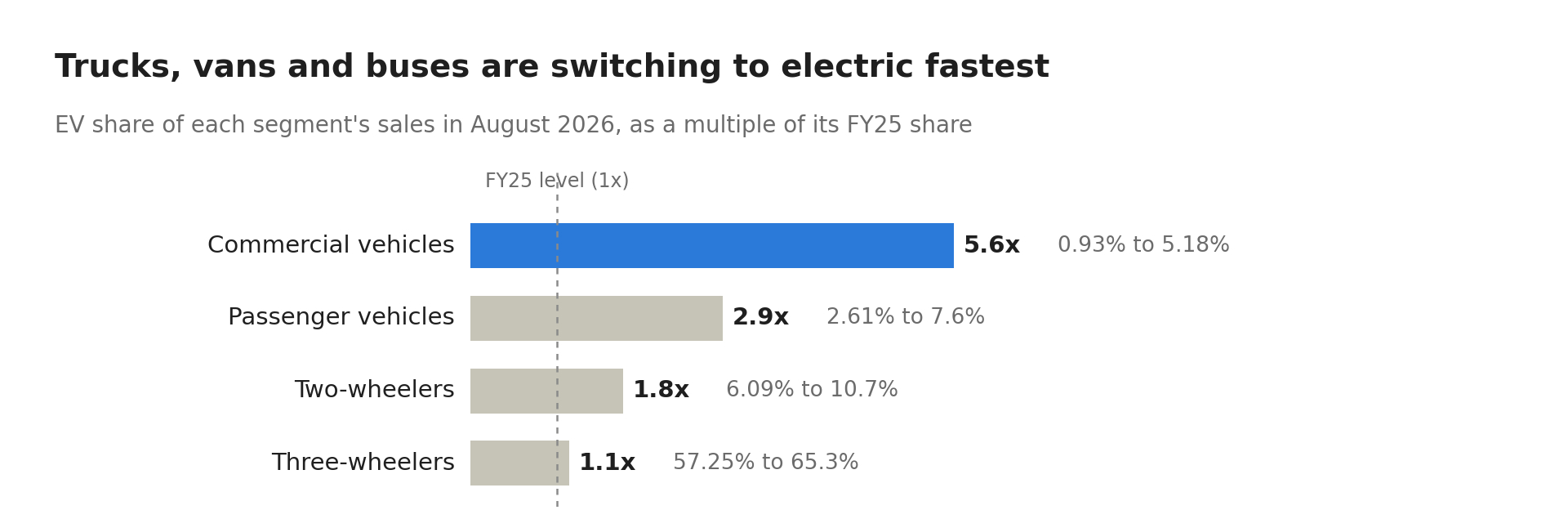 Figure 1. Source: FADA retail data compiled from VAHAN, the government's vehicle registration database; FY25 full year compared with August 2026; 1Lattice analysis
Electric models now take 5.6 times the share of commercial vehicle sales they did in FY25. Three-wheelers are still the most electrified segment at 65.3%, but commercial vehicles are changing fastest and are the segment to watch through FY28.
Passenger cars are where growth is likely to slow first. Dealers are holding 33-35 days of unsold stock, well above the 21 days FADA recommends, and October will be compared with last year's festive rush after the GST cut. Softer year-on-year numbers should be expected this season.
Where the money will go
Over the next 6 to 12 months, the biggest new pool of battery investment will go into the power grid rather than into vehicles. India is adding solar and wind power quickly, but the sun sets just as evening demand peaks. Battery energy storage systems (BESS), large installations of batteries connected to the grid, solve this by soaking up power when it is plentiful and releasing it when it is needed.
The Central Electricity Authority estimates India needs 47.2 gigawatts (GW) / 236.2 gigawatt-hours (GWh) of battery storage by FY32, and 8.7 GW of it by FY27. (GW measures how much power a system can deliver at once; GWh measures how much energy it holds.) In May 2026, the Cabinet approved another INR 5,400 crore of viability gap funding, a government grant that makes projects financially workable, for a further 30 GWh of standalone storage. Central agencies such as the Solar Energy Corporation of India (SECI), NTPC (formerly National Thermal Power Corporation) and Power Grid Corporation of India (POWERGRID), along with state utilities, have since run record tenders. Several now ask for four-hour systems, which can cover the whole evening rather than a short peak.
The opportunity over the next 12 to 18 months lies in the gap between what has been awarded and what has actually been built. About 102 GWh of storage went out to tender across roughly 69 tenders in 2025. By the end of the year, only about 758 megawatt-hours (MWh), less than 1 GWh, was up and running. Our work on the BESS value chain suggests that delivery, not the lowest bid, will decide the winners. In a typical four-hour grid-scale project, the batteries themselves account for roughly 63% of the installed cost, so whoever secures cells at the right price largely decides the returns. Ten of the fifteen biggest storage winners in 2025 were new to the market, and the projects awarded that year will raise finance and place equipment orders through 2026-27. That is the window for system integrators and for suppliers of power conversion equipment, engineering and construction (EPC) services, fire safety and cooling systems. Those who miss it will wait for the next cycle.
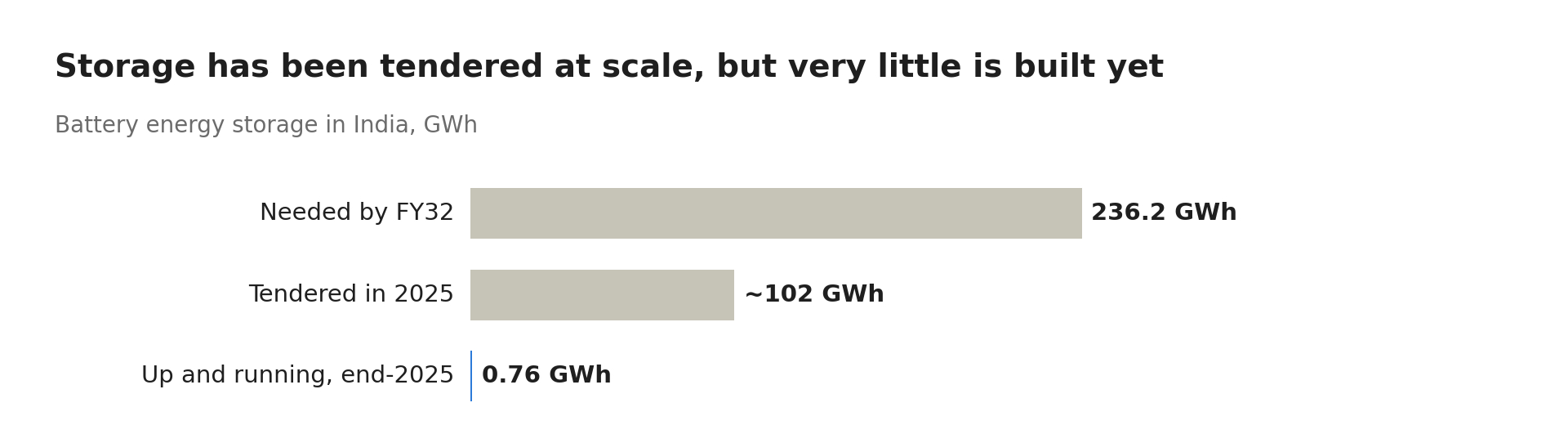 Figure 2. Source: Central Electricity Authority; Wingzman News and Energy-Storage.News tender tracking; 1Lattice analysis. Tendered and built figures are approximate.
Battery cells, the basic units that are wired together to make a battery, come next, and they are the harder part. India needed about 28 GWh of advanced chemistry cells (ACC) in 2025, and the Institute for Energy Economics and Financial Analysis (IEEFA) expects that to reach around 272 GWh by FY30, almost ten times as much. The government's production-linked incentive (PLI) scheme for advanced cell factories has so far commissioned 1.4 GWh of its 50 GWh target, which leaves most of the build-out still ahead. Companies are investing outside the scheme too, with around 76 GWh of initial capacity announced, though most of it will assemble imported cells into battery packs for now. For materials and component makers, the openings are in the chemicals that go inside cells (cathode and anode materials, electrolytes), the electronics that manage battery management systems and power electronics and recycling. These are the layers where India makes the least today, and therefore where local manufacturing has the most room to grow.
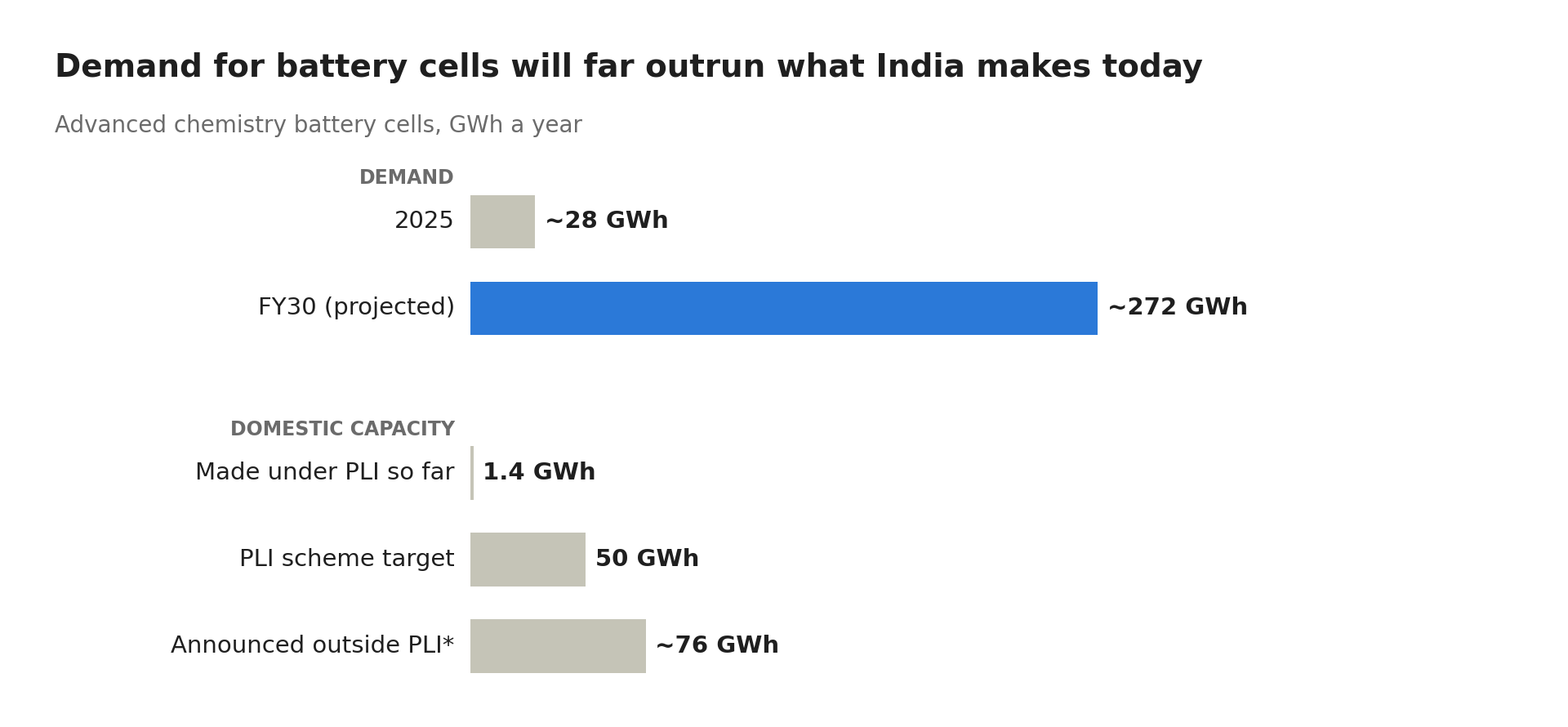 Figure 3. Source: IEEFA; JMK Research; 1Lattice analysis. *Initial phase of capacity announced outside the PLI scheme, largely battery pack assembly for now.
The sectors that will pull hardest
Four areas will drive demand, and the buyer will be different in each.
Last-mile logistics and quick commerce. Our 2026 study of business-owned electric two-wheeler fleets in Bengaluru, Delhi and Mumbai put the fleet at about 4.9 lakh vehicles in 2026, growing at around 17.5% a year to 2030. Quick commerce, the fast-delivery grocery and essentials business, is the biggest user in all three cities. More than half the fleet (54%) already runs on battery swapping, where riders exchange a flat battery for a charged one at a station in minutes instead of waiting to recharge. We expect that share to rise to 76% by 2030.
Commercial vehicles and freight. Electric trucks, vans and buses are gaining share faster than any other segment. Government support for electric trucks, buses and three-wheelers under the PM E-DRIVE (PM Electric Drive Revolution in Innovative Vehicle Enhancement) scheme runs until March 2028, and large shippers have started writing electrification into their logistics contracts.
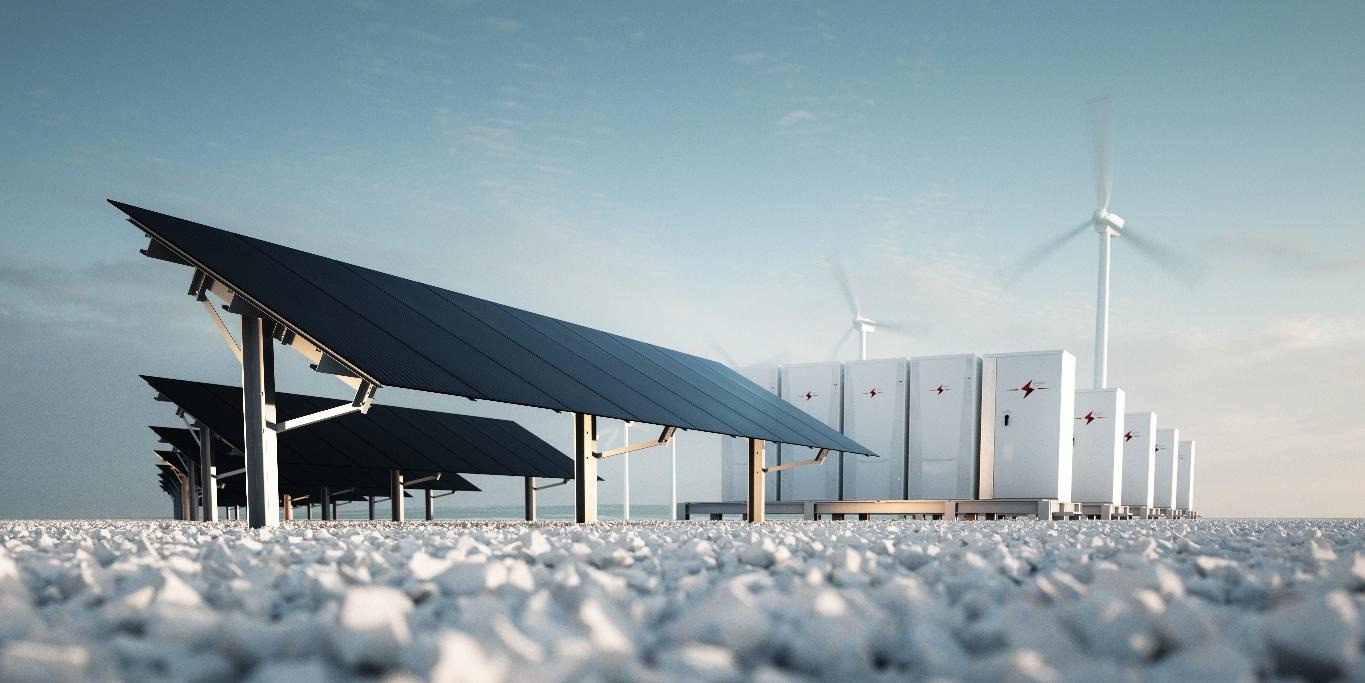
Power and utilities. Battery storage will become a standard part of grid planning through FY32. Expect solar panel makers, battery companies and power producers to keep moving into building and integrating storage systems.
Heavy industry. 1Lattice's Green Spark report sizes India's industrial decarbonization market, meaning spending on cutting carbon emissions from industry, at US$72B in FY24, rising to about US$180B by FY30. Steel, cement, chemicals and mining companies are turning to batteries and heat storage to make solar and wind power reliable enough to run their plants. In cement, reported cases that pair heat storage with renewable electricity show emissions falling by roughly 70-83%.
How business buying will change
One pattern keeps coming up in our research, and it will shape purchasing over the next few years. Buyers care less about the sticker price and more about what an asset will cost over its working life.
In storage, the lowest upfront price is no longer enough to win. Buyers want a supplier with a delivery track record, batteries that lose capacity slowly, solid warranties and a project that banks will lend against. The fleet operators we spoke to choose vehicles and battery partners on uptime, on whether there is a swap station within 2-3 km, and on how quickly faults are fixed. More of them want the vehicle and its energy from a single supplier, and such bundled contracts are likely to become a standard ask. The same thinking is moving fleets to faster electric scooters, because riders can complete more deliveries in a shift.
Dealers are seeing the same shift in showrooms. In FADA's April survey, 56.9% said customers were showing more interest in EVs and compressed natural gas (CNG) vehicles, with worries about fuel prices making buyers look harder at running costs. Suppliers who can quote the total cost of ownership, and stand behind it, will have an edge over those competing on list price alone.
What will top the leadership agenda
Supply-chain resilience will come first. Around 75% of the lithium-ion batteries used in Indian EVs come from China, which also refines about 74% of the world's lithium and produces 98% of a key battery material, lithium iron phosphate (LFP) cathode. The West Asia conflict added another shock: in April, 53.2% of auto dealers reported supply or dispatch disruption. Boards will increasingly ask for a second source, longer supply contracts for cells and a realistic plan to make more locally. Pharma leaders will recognise the pattern from imported active pharmaceutical ingredients (APIs).
Cost discipline will follow close behind. Batteries make up around 63% of the cost of a grid storage project and 40-50% of the cost of an EV, so even small moves in cell prices go straight to margins.
Technology will move deeper into day-to-day operations. Software that manages energy flows, monitors batteries remotely and tracks how fast they wear out increasingly decides whether a storage project or a swap network earns the return it was built for. This is where artificial intelligence (AI) and data tools will prove their worth in the sector.
Talent will be a constraint few people are planning for. Engineers who have commissioned a grid-scale battery project, and managers who have run a swap network at scale, are still hard to find. As storage projects move into construction, this will increasingly set the pace.
Risks to watch in the year ahead
Cell and mineral exposure. China has already restricted exports of some battery materials and manufacturing equipment. IEEFA estimates that without domestic cell production, India's battery import bill could top US$23 billion a year by FY30.
Input prices turning. Lithium prices have climbed back from their late-2025 lows just as a large wave of Indian storage projects is chasing the same cells. Bids priced at the bottom of the cycle could come under strain.
Execution gap in storage. With tens of GWh awarded and less than 1 GWh built, any delay in financing or grid connections could widen the gap further.
Subsidies tapering. Purchase subsidies for electric two-wheelers have been halved and their end dates moved more than once. Any business model that still depends on them needs a plan for a market where lower running costs have to do the selling.
Standards and safety. Three things will shape the economics of battery-as-a-service, where customers rent the battery instead of buying it: common standards that let batteries work across brands (the Bureau of Indian Standards (BIS) swap-battery standard, IS 17896), fire safety rules, and the 18% GST on batteries sold separately from vehicles, against 5% on the EVs themselves.
Looking ahead
Whether India will adopt EVs and batteries is no longer the main question. For the second half of FY27, the harder questions are about execution. Who can secure cells? Who can get storage projects built on time? And who can price a product over its full life rather than per unit? Those are the capabilities worth building now, for battery makers and for the many businesses that will buy from them.
1Lattice perspective
"Batteries are now a common input across mobility, power and heavy industry, and that should change how Indian companies plan their capital spending. Over the next 12 months, the companies that do well will be the ones that secure cell supply, deliver projects on time and sell guaranteed performance along with hardware. Subsidies helped build this market. Execution will decide who holds on to it."